Floating Dock Offers Eco-Friendly Pier Solution
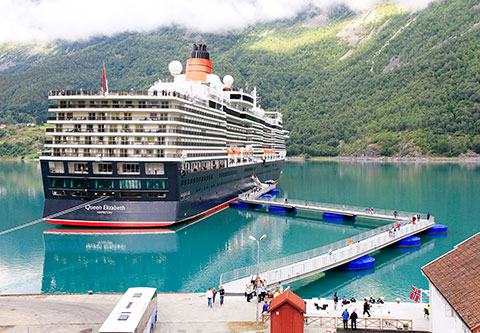
A newly developed floating pier, pioneered in Norway, has been put forward as a potential solution to the economic and environmental challenges of building cruise berthing facilities in Grand Cayman.
The SeaWalk, which brings the pier to the ships, has been hailed as a development that will revolutionize “ship to shore” travel for the cruise industry.
It is currently used at two ports in Norway, and its developers say they are in discussions with 20 more ports across Europe and in the Caribbean.
They say it can accommodate up to 6,000 passengers at a time, can be used in worse weather than tender boats can handle, and would cost less than half the price of fixed piers, with no environmental impact.
Given the relatively short distance between the cruise ship moorings in George Town harbor and the Royal Watler dock, developers believe the walkways could be a good fit for Grand Cayman.
“We have looked at a potential installation in the Cayman Islands for a number of years without really getting down to the nitty-gritty. We have several ideas of two or three ways we could do it,” said Ole Heggheim, a partner in the company.
“The environmental issues are very important for many ports. We think we could find a solution in the Cayman Islands that would not affect the coral reefs at all.”
He said the best option for the Cayman Islands would likely involve up to five floating piers. Piers could be packed away in a major storm, he said, but could be built to withstand rough weather.
“We have systems that can be used for drilling rigs in the North Sea in the middle of a winter storm,” he added.
Cruise Critic travel website reviewed the first floating pier installation in Skjokden, Norway, in August 2012 and highlighted Grand Cayman as the port as “top of the list” of destinations where they would like to see the technology used.
Arthur Kordt, another partner at SeaWalk, said he was keen to talk in detail to politicians on the island to see if something could be done.
Gina Matthews, spokeswoman for the Department of Tourism, declined to comment on the specifics of SeaWalk. She said the credentials of prospective partners for the pier project would be reviewed through an official request for proposal process this year.
“The first step in the process is to identify qualified proponents, and the request for pre-qualification is being released in January 2014. After the successful qualified proponents have been identified, the various technical issues will be addressed as the project develops,” she said
The business case for piers, produced by PwC for the government, did not countenance a floating pier option in any of its suggested scenarios.
The preferred option highlighted in the report was two fixed piers to be built at the current location of the Royal Watler dock for an estimated cost of between US$100 million and $200 million.
An environmental impact assessment will be carried out on the plan, which would involve the destruction of some reef in the harbor and 626,000 cubic meters of dredging – equivalent to 250 Olympic-size swimming pools.
Potential erosion on Seven Mile Beach and “sediment impacts” along the coast have been highlighted as initial environmental concerns in a preliminary document outlining the intended scope of the environmental impact study.
Mr. Kordt said, “We would like to think we can find a solution for Grand Cayman that would have zero impact on the environment. We would have to put out some buoys, but that would be outside the coral reef line.
“We got permission to install the SeaWalk at a UNESCO-protected fjord in Norway, so we are able to work in environmentally sensitive areas.”
He said the SeaWalk provides the same level of passenger comfort as a regular pier, is accessible for disabled people, and requires only a short walk to shore.
“The distance passengers would have to walk would be far less, for example, than in the average airport,” he added.
Source: Cay Compass (Cayman Islands)