Port of New Orleans Files Lawsuit against Tanker Owners following Mississippi River Collision
Legal Action Demands Immediate Financial Restitution, Secures Court-Ordered Vessel Seizure, and Highlights Severe Infrastructure Damages Following a Near-Miss Collision with the River Cruise Ship American Heritage
The Port of New Orleans has officially filed a high-stakes federal lawsuit in United States district court against the owners and operators of the asphalt tanker Atlantic Asphalt, stemming from a dramatic and destructive collision on the Mississippi River. The legal action targets the vessel's severe steering failure, which led directly to significant structural destruction at the Thalia Street terminal and nearly resulted in a major maritime disaster involving a docked passenger cruise vessel.
Initial court filings show that port authorities are seeking an immediate 1 million dollars in baseline damages to cover structural repairs, environmental clean-up operations, and technical safety inspections. However, maritime experts and port administrators anticipate that the final financial assessment will escalate significantly as divers, engineers, and legal auditors complete their comprehensive evaluations of the harbor infrastructure and prolonged operational disruptions.
To guarantee that the port authority and affected operators secure full financial compensation, federal judges approved a formal prejudicial seizure warrant, effectively placing the Liberian-flagged tanker under legal arrest. This protective measure ensures that the vessel cannot depart local waters until corporate stakeholders post substantial financial bonds to satisfy potential court judgments or settlement agreements.
The lawsuit explicitly names Nave Shipping SA, the vessel owner and a subsidiary of the China State Shipbuilding Corporation, alongside ship management firm Thome Ship Management. Legal representatives for the port charge both organizations with gross operational negligence, inadequate mechanical maintenance, and failure to maintain proper navigational control within a high-traffic commercial waterway.
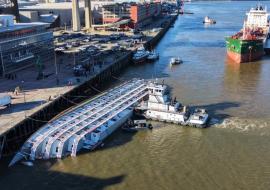
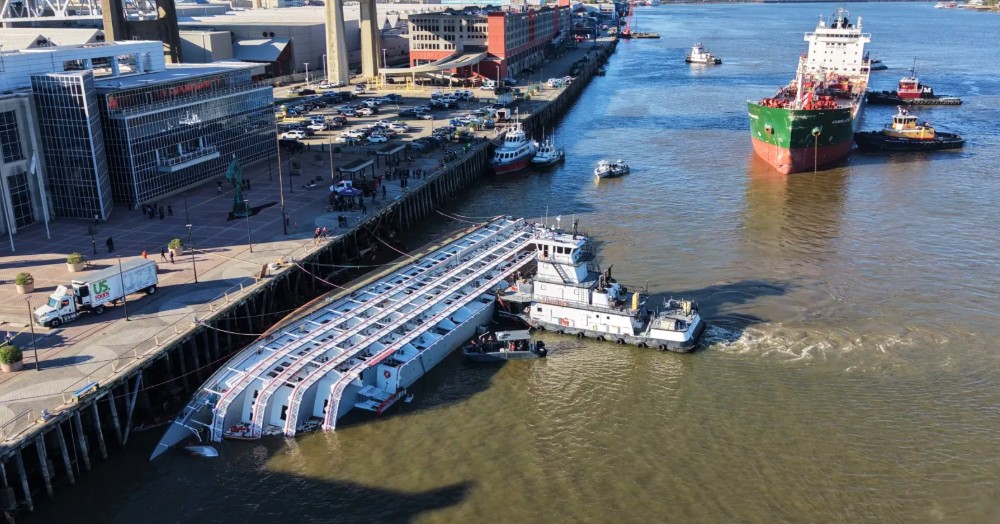
The terrifying incident unfolded when the Atlantic Asphalt suffered an abrupt, catastrophic loss of steering control while navigating the swift currents of the river. Unable to correct its trajectory, the massive tanker careened directly into the American Heritage, a specialized river cruise ship operated by American Cruise Lines, which was securely berthed with passengers and crew members aboard.
The violent impact caused the passenger vessel to list heavily before partially capsizing against the pier, throwing several individuals into the water amid widespread panic. Thanks to the immediate and heroic response of local emergency rescue teams and harbor tugs, all passengers and crew were swiftly pulled to safety, resulting in the miraculous absence of any fatalities or critical injuries.
Meanwhile, investigators from the National Transportation Safety Board (NTSB) continue their exhaustive technical probe into the mechanical roots of the steering failure, examining whether maintenance logs or onboard control systems contributed to the accident. As the legal proceedings unfold, the incident underscores the vulnerability of urban port infrastructure and intensifies scrutiny over maritime safety standards along vital domestic shipping corridors.