
The 2026 Tourism Map: Between Global Records, the U.S. Pullback and the Hangover of Overtourism

International tourism reaches 1.57 billion arrivals in 2026 and lifts global spending by 9% to €6.97 trillion, according to data from Tourism Economics presented at World Travel Market London.
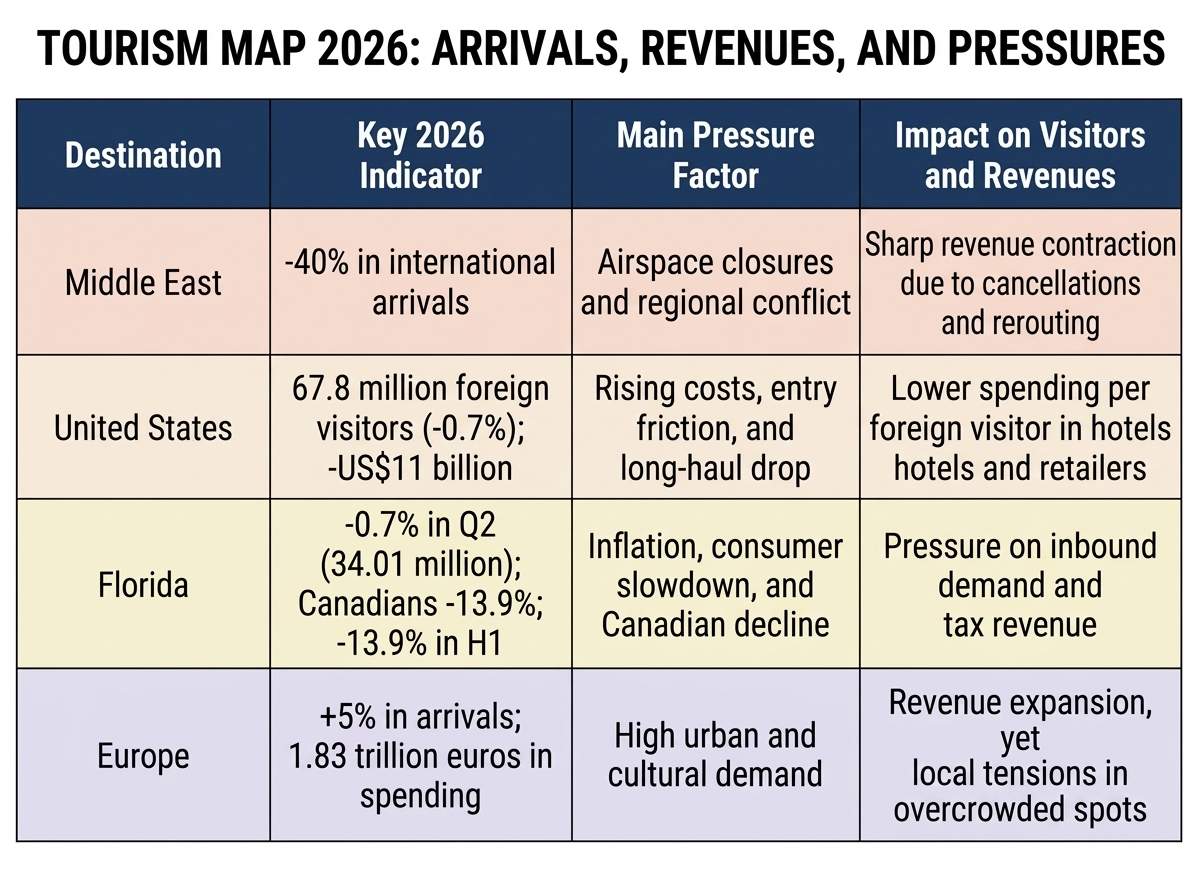
However, the picture is far from uniform: while Europe projects a 5% rise in arrivals and Asia-Pacific accelerates in connectivity and spending, the United States faces a 0.7% drop in international visitors to 67.8 million, with projected losses of US$11 billion and foreign spending still 25% below 2019 adjusted for inflation.
The fracture across the tourism map stems from three intersecting forces: travel costs, geopolitical tensions and social friction in overcrowded destinations. Budget-conscious travelers are shifting routes toward markets with stronger value for money, while other hubs confront environmental strain, resident backlash and rising operating costs.
The Winners: Europe, Asia-Pacific and High-Momentum Destinations
Europe consolidates its inbound leadership in 2026 with a 5% gain in international arrivals and €1.83 trillion in combined spending, backed by resilient demand favoring cultural getaways and urban itineraries. In parallel, Asia-Pacific posts some of the fastest expansion rates on the back of stronger air connectivity, recovering long-haul flows and higher per-visitor spending.
Mexico stands out as one of the most dynamic engines in the Americas, posting 14.6% growth in arrivals to the United States during the first half of the year and a 10.3% projected overall gain in inbound tourism activity despite softer overseas markets. South America also adds momentum, recording a 3.8% increase in arrivals to the United States over the first eight months of the year compared with the prior period.
On airfares and search appeal for 2026, Skyscanner's Travel Trends Report points to sharp drops in average flight prices to cities including São Paulo (-29%), Singapore (-25%), Venice (-21%), Mexico City (-19%), Istanbul (-18%), Denpasar (-17%) and Seoul (-14%), expanding travelers' on-the-ground spending power.
Hit Hard by Revenue Drops and Geopolitical Tensions
The Middle East absorbs the steepest shock of 2026, suffering a 40% drop in international arrivals triggered by airspace closures and operational disruptions tied to regional conflict. That safety and connectivity squeeze translates directly into lost revenue for airlines, hotels and air traffic operators.
In the United States, the 0.7% contraction in international arrivals —revised downward from 69.9 million in July to 67.8 million— is accompanied by a 5.2% decline in long-haul markets (excluding Canada and Mexico) and a 11.7% drop from the Middle East and Africa. The Canadian market remains under pressure after falling 21% in 2025 and projecting another -3.3% in 2026, while Florida logs two straight quarters of contraction (-0.7% in the second quarter to 34.01 million visitors, with a 13.9% drop in Canadian travelers during the first half).
Although domestic tourism in the United States reaches 2.44 billion trips and accounts for roughly 88% of total spending, total tourism spending adjusted for inflation slips 0.7% to US$1.35 trillion, hitting hotels, retailers and attractions reliant on foreign visitors the hardest.
Destinations on the Tightrope of Overtourism and Costs
Beyond arrival tallies and currency inflows, 2026 travel guides and analyses —including Fodor's No List and traveler-experience reports— warn about destinations where mass tourism, gentrification and inflated prices erode local cohesion or visitor quality.
Mexico City faces protests over rising housing costs and overtourism; Venice, Barcelona, Rome and Santorini accumulate friction from crowds, restrictions or high costs; and fragile enclaves such as Antarctica, Glacier National Park or Mombasa experience environmental wear or infrastructure strain.
In 2026, winning or losing in tourism no longer hinges solely on drawing crowds: destinations that protect their net profitability, infrastructure and local acceptance are the ones sustaining real growth amid global volatility.