ALTA Annual General Assembly Tackles Aviation in the Americas
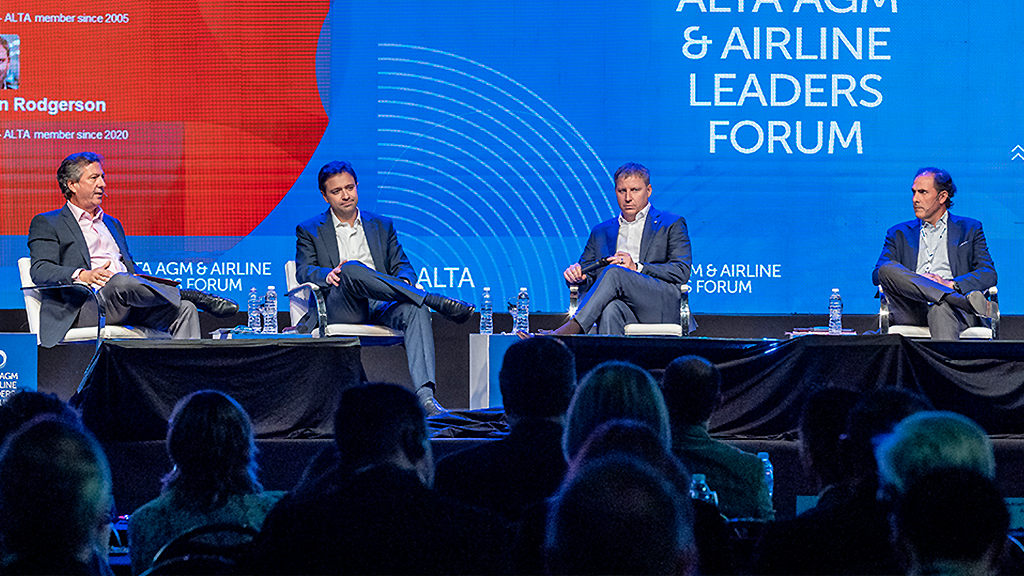
The recovery of passenger demand in Latin America, the consolidation of some airlines in the United States and Europe, as well as the challenges that remain to be overcome in the post-pandemic era were some of the topics addressed by the panel "The growth of aviation facing new challenges”, within the framework of the 18th edition of the ALTA Annual General Assembly and Leaders Forum, which takes place in Buenos Aires, Argentina.
In the panel, moderated by Alex De Gunten, HEICO Aerospace Business Development Officer, the CEOs of Iberia, Javier Sánchez-Prieto; from GOL, Celso Ferrer and from AZUL, John Rodgerson, exchanged the experiences of their companies to overcome the pandemic and the actions they consider should be taken by the sector and by governments.
Javier Sánchez-Prieto, CEO Iberia, highlighted that the industry has been able to recover in many aspects, despite the current uncertainty, which is not new, since aviation has had to face other challenges before Covid-19, such as recessions and high fuel prices, which the industry has been able to overcome.
“The good thing is that we turned the page and came back. The demand is back, there are many problems, but we are good in some aspects. We are seeing in some sectors higher growth. We failed in the predictions in terms of prices and how we are recovering from the crisis. We are also seeing a much stronger recovery in corporate traffic, which is good news. I think this is the starting point. We know that we have to live now with a certain degree of uncertainty, but that is what we have in this industry,” said Sánchez-Prieto.
He mentioned three challenges facing aviation: Making the industry work (the recovery has to do with not having long queues at each airport, that's not good, neither are the different regulations); understand that the industry is instrumental for social and economic development and not see sustainability as a threat, but rather as a challenge.
The CEO of Iberia also highlighted that there is a connection that must be followed and that it has to do with the customer. "This is something we have to invest in if we want to protect our industry."
Celso Ferrer, CEO of GOL, also sees a positive scenario. “I see a better picture. We are facing a very big crisis and we are reaching the post-crisis stage. It's going to take us at least two years to somehow reduce the lag or lethargy in the industry."
He pointed to the actions they are taking after the pandemic, which is to go back to basics: bring all the planes back and take the actual budget as a basis. “We reduced the network from 800 games a day to 50 games a day. During the crisis, we saw work in relation to day-to-day management, and in this post-crisis moment, we can combine a long-term vision with a medium-term vision, which It's where we are today."
He added “despite fuel costs we see less volatility, which is good. We are adjusting to be able to stimulate the business and also for the company to grow again. Today we fly more or less 90% of what we flew pre-pandemic and the idea is that in December of this year we will reach 100% of pre-pandemic flights.
After the Covid-19 crisis, GOL made crucial decisions: the integration of the frequent flyer program, which has been growing very fast (passengers are adding miles and want to travel much more); renewal of the fleet (more than 35 aircraft were incorporated in 18 months) and the integration of a new platform to offer a better digital experience to the customer.