The Caribbean Gets Major Tool to Deal with Tourism Vulnerabilities
by Veronica de Santiago and Jorge Coromina
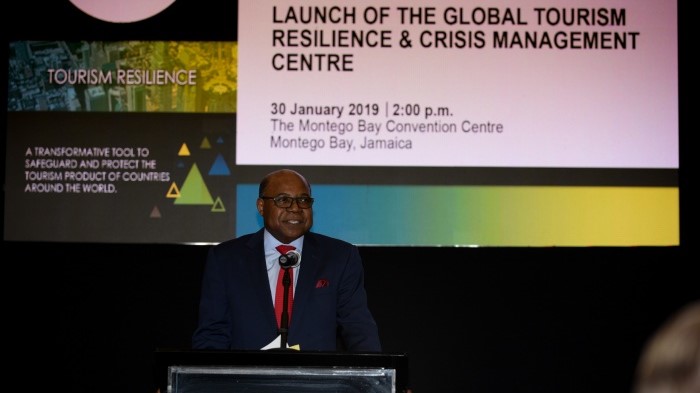
After two years in the works, following a mandate of the UNWTO unveiled in November 2017, Jamaican Tourism Minister Edmund Bartlett officially launched the Global Tourism Resilience and Crisis Management Center within the framework of the CHTA Caribbean Travel Marketplace taking place this week in Montego Bay.
The inaugural ceremony. held at the Montego Bay Convention Center, had former secretary general of the World Tourism Organization Taleb Rifai, assistant secretary general of the UNWTO, Jaime Alberto Cabal, and Richard Bernal, vice chancellor of the University of West Indies, in attendance.
“Today we launch the first ever Global Tourism Resilience and Crisis Management Center. The importance of a resilience and crisis management center cannot be overemphasized at a time when travel and tourism are increasingly expanding,” says Edmund Bartlett, tourism minister of Jamaica.
Mr. Bartlett explained that with 10.4 percent of global GDP, tourism stands out and provides one in ten jobs. Las year, as many as 1.4 billion people traveled across the world, spending $7.8 trillion in their stays.
“It’s a huge industry. One in five jobs in the Caribbean are directly related to tourism, while more than 40 percent of the GDP of the Caribbean is directly related to tourism,” Minister Bartlett went on to say.
According to the UNWTO, the Caribbean is a region that depends heavily on tourism. Thirteen of the world’s 20 most tourism-dependent nations belong to the Caribbean, with Antigua & Barbuda topping the list and Jamaica holding the 13th spot.
The importance of this center is the ability to deal with high levels of vulnerabilities that affect tourism. Now the challenge is to create the capacity to respond to those vulnerabilities with resilience.
During his keynote presentation, Mr. Bartlett underscored the importance of the center at a time when the travel industry seeks to be fully sustainable and keep the environment intact. In his opinion, “we have to go one step further. To be able to survive, we need to be sustainable; to thrive is to be resilient,” he concluded.
For his part, Taleb Rifai, former secretary general of the UNWTO, said the center now becomes a crucial part of the everyday life, something that will be more than just an economic activity.
“We can become better people when we travel, and everybody must feel the same way. We travel and we compare each other, we see beauty and energy, we see people really as they are,” Mr. Rifai said.
The venue of choice for the center will be the University of the West Indies, a global institution based in the Caribbean region and featuring three campuses and twenty subcampuses across the Caribbean.
With both international staff and student body, plus three Nobel Prize winners, the university has the expertise and knowledge the center needs to deal with the issues it must face from now on.
It counts on a research center on tourism policy and it has helped the region to cope with disaster management situations.
“We’re the leaders in financial studies, and those are strengths that make the University of the West Indies the right place to harbor this center,” said Richard Bernal, vice chancellor of the University of West Indies.
“In small island states and developing countries, where tourism is a major economic activity, climate change generates loss of jobs and revenue, let alone a decline in social and economic prosperity,” Mr. Bernal told the audience attending the Caribbean Travel Marketplace in Montego Bay.
“However, the GTRCMC is a formidable rectorial institution for the Caribbean in the face of natural disasters. Nevertheless, from this day on we can say that tourism is now safer in the face of vulnerabilities as the center will protect travel destinations around the world,” he concluded.
The center will assist with preparedness, management and recovery from disruptions and/or crises that impact tourism and threaten economies and livelihoods. It is aimed at assessing, forecasting, mitigating and managing risks related to tourism resilience, caused by various disruptive factors.
Major partners in the center include United Nations World Tourism Organization (UNWTO); World Travel and Tourism Council; Caribbean Hotel and Tourism Association; Caribbean Tourism Organization; and the Jamaica Hotel and Tourist Association (JHTA).