One on One with the CHTA President
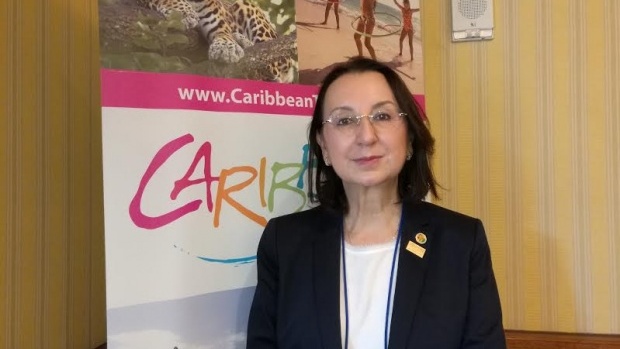
Q & A with Karolin Troubetzkoy, President of Caribbean Hotel and Tourism Association (CHTA)
Within the framework of the Caribbean Travel Marketplace 2017, held recently in the Bahamas, Caribbean News Digital sat down in an exclusive interview with Karolin Troubetzkoy, president of Caribbean Hotel and Tourism Association (CHTA).
You have been the president of CHTA for a year and, since the very beginning, you said that in your role as president you were looking forward to expanding marketing, advocacy, sustainability, educational and culinary effort. How do you feel looking back for the first year?
I feel that there is very few hours left to sleep. When you take on a voluntary role as president of CHTA, it is labeled voluntary, but there really is a lot of work to be done and you end up adding a lot of hours to your work day. However, I remain very optimistic and very passionate about the areas that I identified in the beginning of my term.
In the area of sustainability, I’m pleased that I have the very active and determined support of the chairperson of the committee that we call Caribbean Alliance of Sustainable Tourism (CAST). With her, we have developed an action plan on what we can do for our national hotel associations.
We are planning an initiative to bring sustainability training to young children, for example. We are working very closely on best practices when it comes to solid wastes, but also waste water management and water management. We are also highlighting the vulnerability of the region to climate change and avoiding shorelines in particular.
Again, we haven’t stood still, but everything takes time for us to really develop the plan. Hopefully, the next few months will allow us to also showcase and, I would say, complete some of the actions plans that we have first set out to fulfill.
In terms of education, I’m very pleased to have been able to sign MoU’s for a number of organizations that offer training, such as Springboard and Forbes Travel Guide; we have also created an initiative, a developing initiative, which will help us deliver and bring more training opportunities to our national hotel associations whether these training opportunities would be onsite in various destinations or whether they are going to be online.
The point here is that in the Caribbean we all look forward to all the new developments that, thank goodness, are taking place, the new properties that are being opened. We must ensure that there is enough skilled workmen, enough skilled hospitality workers out there that are hirable, employable by these new developments.
What we don’t want to see is that they steal skilled workers from each other, so we want to really grow the employable population with every new development and, of course, help them bring employment.
In the areas of training, many islands are training in culinary arts. There is an opportunity also in training for customer service, plus you also have opportunities to really offer training in property management from the technological side, like air conditioning, IT event lighters, many opportunities.
My most passionate topic in this area will be the culinary arts. I feel that here we must do some work and highlight. Caribbean nationals see a great opportunity in culinary arts.
Going back to sustainability on the broadest aspect of sustainability, when you also look at the cultural side I feel there is tremendous opportunity to help grow creative arts in the region and also create the linkages to tourism for creative arts.
At all times, we want to also create much closer linkages to our agriculture and work together the bring the high food import bill that we all have down and use local products a lot more.
As for the public and private sectors, you are working hand to hand with the public sector to make a brand: Brand Caribbean.
There is tremendous opportunity. Though other areas where private and public sectors can collaborate if you look at the issue of sustainability, for example, the most important area where we feel we could really grow visitors numbers to the Caribbean if the public and private sectors work together and recognize the importance of search a regional marketing strategy. Such strategy would have to be funded and I think the most important topic of discussion would have to be how to fund and sustain the marketing campaign for the region.
I am a big supporter of a regional marketing campaign and strategy because it concerns me that UNWTO states that by 2030 we will not have grown, the Caribbean will not have grown the global tourism market segment. We will actually have gone down and reduce the segment. It is now 2.1 percent and the Caribbean holds a global tourism share of 2.1 percent.
UNWTO predicts that our global market share will go down to 1.7 percent by 2030. That should not be the case. We should grow our market share and not face a reduction of it.
You mentioned digital marketing. Does it include social media?
Yes. In the past, when our regional strategy was discussed it was still focused on traditional marketing such as printed advertising and television, which is very costly. I think there is tremendous opportunity now embrace what can be done on a digital platform from social media and even on YouTube, with short video clips on what the Caribbean has to offer. I’m excited that I feel there is a new opportunity at social media scale to highlight the Caribbean.
What is interesting to me is that the people that work in the Caribbean industry, live and work in the Caribbean tourism industry, we make a mistake and think that the entire world of visitors actually understands the Caribbean.
Very often, when I’m being asked “where are you from” and I say “I’m from St. Lucia, in the Caribbean”, the person answers “You are from the Caribbean. I have been there”. Of course, I answer “what precisely do you mean you have been to the Caribbean”.
I think the opportunity is to highlight the amazing diversity of what the Caribbean really has to offer and turn a one-time visitor into a life-long supporter and loyal visitors to the Caribbean. I always like to say that the Caribbean should not be considered a vacation of a lifetime, but a lifetime source of vacation experiences.
Two days ago, we saw the results for 2016 and there were great results, but we also saw new challenges that the hoteliers in the Caribbean have to deal with. For example, vacation rentals. What are the expectations and new projects to work with hoteliers and try to solve the problem of the sharing economy?
We feel there is tremendous opportunity for an organization like the Caribbean Hotel and Tourism Association to work on behalf of all of our destinations and showcase the best practices of how other destinations have handled the issue of sharing economy. There is no doubt that this sharing economy is here to stay. We have to find a way to integrate it into what’s happening.
However, it has to be a fair plain field and our governments simply must be encouraged to license and register these types of accommodation and find a way to tax them. I think that hoteliers will be a lot happier to have them work alongside.
Cuba is growing so quickly. Do you think that the rest of islands and hoteliers in the area consider it is a threat?
This is an interesting new challenge for our existing tourism in the Caribbean. It is a challenge for some destinations because Cuba has more competition out of North America. As you know, for many destinations North America is the main feeding market. Cuba has been existing in the global perspective for a very long time. It is a very successful tourism destination.
However, as the Caribbean Hotel and Tourism Association we see the opportunity instead of the challenge. We see the opportunity that we have a destination that we can finally embrace fully. Most importantly, the Cuban Ministry of Tourism has indicated to us the desire to be part of any regional strategy that we wish to pursue and that made us very happy.
Cuba has indicated very clearly to us that they understand the importance of a regional marketing strategy, that they want to be part of it, play a part in it and they also wish to play a part on any effort we make to make the region more sustainable and that made us very happy.