Tampa Firm Promotes Jose Marti Trail as Tourist Destination
The Tampa area already struggles against Orlando, the top tourist destination in the world, to gain a share of the visitors who come to spend money in Florida.
Soon, Orlando will begin competing for one of the attractions that makes Tampa unique in Central Florida — regular flights to and from Havana. They begin this summer, flying each Wednesday.
But a Tampa public relations firm is working on giving this region an edge, at least with its Cuba connection: The “José Marti Trail,“ a tour of spots in Tampa linked to the man whose role in winning independence from Spain earned him the nickname “The George Washington of Cuba.”
Marti will never be Mickey Mouse or the Miami nightlife when it comes to drawing tourists, but he has a following. And recent political developments may enable Tampa to cash in on it.
Growing normalization of relations with the Communist nation includes an easing of the travel ban.
Trips between the countries for purely tourism reasons still are prohibited. But people in the U.S. can visit Cuba now, so long as they fit one of 12 categories of travel — including cultural-education programs.
TuckerHall, an international public relations firm headquartered in downtown Tampa, hopes travel services that already put together educational trips to Cuba will add Tampa to their itineraries, featuring the pivotal role the city played in launching the revolution Marti inspired.
There’s no sign anyone is doing it already. TuckerHall kicked it off with the launch in April of a website, www.JoseMartiTrail.org, built around a map that features 11 stops of significance to Marti’s life and cause.
It’s a pro bono project for TuckerHall. The firm has no plans on getting into the Cuban travel business. In time, the company aims to erect historical markers at each stop and add audio to the website so tourists can listen to a walking tour on their mobile phones or tablets.
Perhaps owners of buildings on the tour will allow small exhibits, Carlson said. New stops will be added as scholars alert the company to other historical possibilities.
Marti’s planning and early fundraising for the 1895-1898 War of Cuban Independence took place in Tampa, primarily Ybor City. People in Tampa, some of Cuban descent and some not, were inspired to accompany Marti to the island nation to fight by his side.
Among the stops on the Marti tour is the “El Pasaje” Cherokee Club building at 1320 Ninth Ave., where Marti once stayed. It is now an office building for Radiant Oil Co.
Then there is the Vicente Martinez Ybor Cigar Factory, where Marti delivered one of his most famous speeches in support of Cuban independence. It is now the Ybor City headquarters for the Church of Scientology.
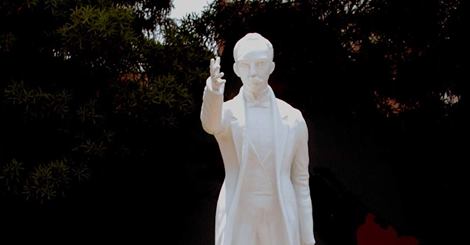
And José Marti Park is at 1303 Eighth Ave., once the location of the home of Paulina and Ruperto Pedroso, who saved Marti when he was poisoned by would-be assassins from Spain. Today, a statue of Marti is erected there.
In June, this bond between Cuba, Marti and Tampa may grow stronger when Albert Fox, executive director of the Tampa-based Alliance for Responsible Cuba Policy Foundation, brings Rafael Polanco to Tampa.
Palanco is head of Cuba’s Jose Marti Cultural Society, a non-governmental organization dedicated to preserving and spreading the history of the freedom fighter throughout the world.
Fox said the society has chapters in 92 countries, but none in the U.S. Cuba’s popularity among tourists is growing, according a recent report from its Ministry of Tourism.
In the first quarter of 2015, international visitors to the island nation increased by 14 percent from the same period in 2014, bolstered by a 30 percent increase among U.S. visitors that coincided with President Barack Obama’s executive orders making travel there easier.
Travel to Cuba from Tampa International Airport during the first quarter of 2015 is up by almost 1,000 passengers over the same period a year a year earlier — 17,075 through the end of March 2015 compared to 16,129 through March 2014, the airport reported.
Five charter flights travel from Tampa to Cuba each week. The numbers already had been growing, from 41,526 passengers in 2012, to 45,595 in 2013 and 61,408 in 2014.
Miami, New York, Key West and Fort Lauderdale are the other U.S. cities that offer charter flights to the island, though New York has just one a week and Fort Lauderdale uses planes that seat only nine, said Tom Popper, president of New York-based Insight Cuba, which has been taking American tour groups to Cuba since 2000.
Island Travel & Tours, which used to operate charters to Cuba from Tampa International, will run the once-a-week charter service from Orlando International Airport. If demand warrants it, Island Travel will add a second flight Sundays.
New Orleans is considering Cuba flights, too. The first direct flight from New Orleans to Cuba since 1958 took off March 14 carrying a delegation of leaders. That flight could be followed by others if there is demand. New Orleans, Fox said, could provide Tampa competition for educational travel packages.
According to historians, Marti also raised money in New Orleans. Antonio Maceo, the second highest-ranking Cuban military officer during the war, lived briefly in the Cajun city before returning to the island for battle. In addition, a volunteer infantry departed from New Orleans to fight alongside the Cuban troops.
Source: The Tampa Tribune