WTE Miami 2023: Iberia Keeps Building Bridges from Europe
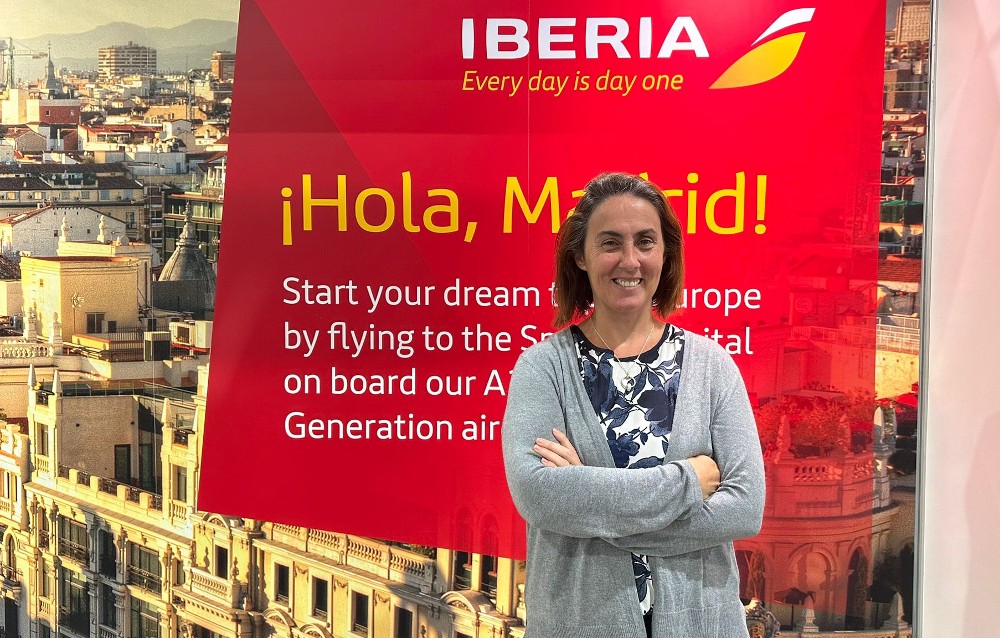
In the framework of the World Travel Expo in Miami, Marina Colunga, Iberia's Commercial Director for Latin America, tells us about some of the news of the Spanish airline and its frequencies in the United States and Latin America.
With what expectations does Iberia come to this fair? What support is it receiving?
Our expectation is always to support and encourage any travel initiative. At Iberia we have a very specific objective and purpose to increase our footprint, both in the United States and in Latin America. This is still a small show, but we believe in its potential and we are very happy to be here.
The increase in seats to Latin America is also demonstrating that...
We always say that Iberia is a Spanish company with a Latin American heart and that our operation in recent years has gone through different phases, like the industry in general. The good thing is that both in the United States and in Latin America we are already finding our capacity at higher levels. There is a very concrete growth plan for Latin America; however, the United States is currently the country where we fly to the most cities within the same system, so I think it is a positive story.
Miami is one of the most demanded destinations from Spain, specifically from Madrid.
Yes, Miami is undoubtedly important for us, not only for the United States but also for Latin America in general. We currently operate two daily flights to Miami, together with the other two daily flights we have to New York. These are the two cities within the U.S. where we have the most frequencies. It would not be fair to say that Miami is the only one; we have found business opportunities where there is, for example, the addition of Washington D.C. or Dallas to the system. But Miami is undoubtedly a very important departure and arrival point for Iberia.
What are the airline's novelties for this summer?
Between April and October we plan to have many more seats available in this market. We have the recovery of routes that we had not operated last year, such as San Francisco; additional frequencies in Los Angeles or Washington. We are prepared globally, not only in the U.S. We are prepared for a very strong summer, with new employees in airports, operations and crews. It's a long-term strategy in which the U.S. is a key part. In addition, although it is not a novelty as such, we have a project called Hola Madrid that offers the possibility of staying up to seven days on your entry to Europe in the city of Madrid, at no additional cost, and it is also worth remembering that on long-aisle flights we have the Premium Economy category.
Is the new fleet, the A321 long range, also part of this strategy?
Of course, the renewal is constant. During 2022 we will incorporate thirteen aircraft, of which seven are A350s. We are visualizing an additional five for this year. It is not only an operation in terms of sustainability, more efficient, since the lower fuel use allows us to operate more profitable routes and in some way support the environment. The increase in fuel has an effect on tickets, but the good news is that demand remains strong and we are looking for a way to reinvent ourselves to make it more sustainable and more profitable.
As for Latin America, is that demand also being seen on routes that have not been reactivated?
Latin America is in an extraordinary moment. As a company we have a growth plan, we have already reactivated all destinations and we have more frequencies compared to last year. In Mexico, for example, we did not have the three we have now and we have gained one. The news for Latin America is very positive and comes from the demand for travel to Europe, which continues to be strong. We have a competitive advantage and we are taking steps, perhaps short but firm, to continue boosting not only trade but also the economies of Latin America.
How important do you think airlines are in the Latin American tourism economy?
Obviously each country, depending on how industrialized it is, has a greater or lesser contribution, but they are a fundamental part of the economies, especially in the generation of international currency. Latin American countries live in a different reality in terms of currency volatility, so I believe that tourism, travel and access to international exchange continues to be one of the fundamental priorities in terms of economies.
And, at the end of the day, Iberia is still the gateway to Europe....
We like to think of ourselves as the connecting vehicle. I always say that there are people who build walls and there are others who build bridges, and we are proud to say that we are that bridge and that we are committed both to bringing Latin America to Europe and Europe to Latin America.